

As temperatures cool and many men return to consistent workout routines after the busy summer months, heel pain can quickly become the biggest obstacle to staying active. Whether your goal is to lift heavier, hike longer, improve your cardiovascular fitness, or simply enjoy daily walks without discomfort, plantar fasciitis can make every step feel like a setback.
Plantar fasciitis is one of the most common causes of chronic heel pain, affecting millions of adults each year. It develops when the plantar fascia, the thick band of connective tissue supporting the arch of the foot, experiences repetitive stress that exceeds its ability to recover. Over time, microscopic tissue damage accumulates, leading to persistent pain, stiffness, and reduced mobility.
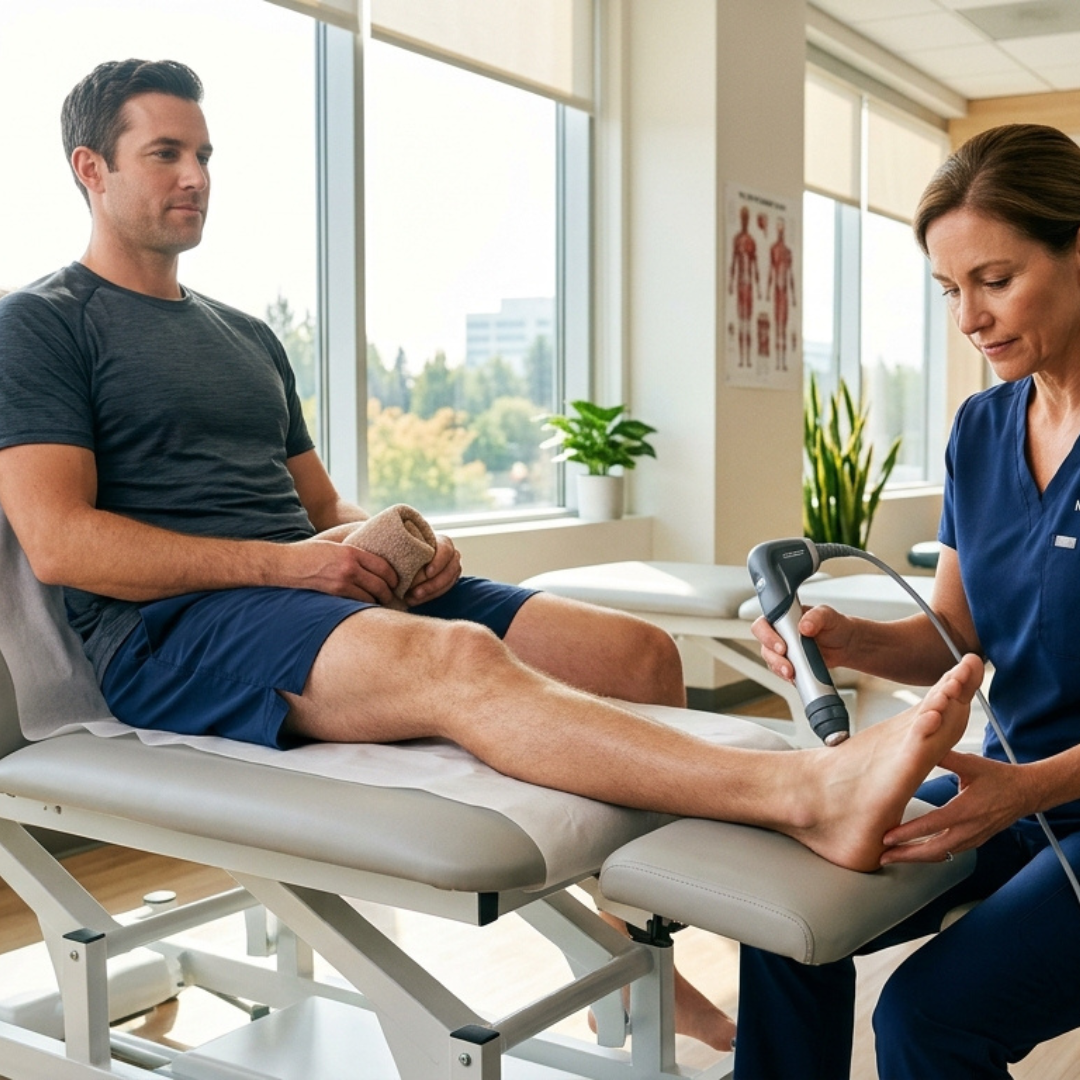
At Hightower Men’s Clinic, we offer a regenerative, non-surgical approach using Pulse Wave Therapy (PWT). Rather than masking pain with medications or repeatedly suppressing inflammation with injections, our treatment focuses on stimulating your body’s natural healing response to restore healthier tissue and improve long-term function.
Why Traditional Plantar Fasciitis Treatments Often Fall Short
Many men attempt to manage heel pain with stretching routines, over-the-counter pain relievers, shoe inserts, or temporary activity modification. While these treatments may reduce symptoms in the early stages, they often fail to address the biological changes that occur in chronic plantar fasciitis.
Clinical research now shows that long-standing plantar fasciitis is not simply an inflammatory condition. Instead, the tissue often becomes degenerative—a condition known as plantar fasciosis—characterized by disorganized collagen fibers, reduced microvascular blood supply, and diminished healing capacity. Because of this structural shift, simply reducing acute inflammation fails to resolve the underlying problem.
Traditional management strategies carry distinct physical limitations:
- Anti-Inflammatory Medications: May temporarily reduce discomfort but fail to repair damaged, degenerated connective tissue.
- Repeated Corticosteroid Injections: Provide short-term pain relief, but repeated injections can weaken the plantar fascia tissue and significantly increase the risk of a full tissue rupture.
- Extended Rest Alone: Temporarily decreases acute symptoms, but prolonged inactivity causes muscular weakness and leads to recurring pain the moment exercise resumes.
- Orthotics Without Rehabilitation: Supportive footwear reduces structural strain, but shoe inserts cannot regenerate damaged fascia or restore native collagen quality.
When chronic tissue degeneration remains untreated, workouts become increasingly difficult, daily walking becomes painful, and overall physical activity declines.
How Pulse Wave Therapy Supports Natural Healing
Targeted Pulse Wave Therapy uses low-intensity acoustic sound waves that penetrate deep into damaged tissue without surgery or invasive injections. This mechanical stimulation activates several biological repair mechanisms that have been extensively validated in musculoskeletal medicine.
Stimulates Deep Tissue Remodeling
The acoustic waves trigger mechanotransduction, a cellular process in which physical energy signals cells to release vital growth factors. This encourages healthier, parallel collagen production and supports active remodeling of the damaged plantar fascia.
Improves Local Blood Flow via Angiogenesis
Chronic plantar fascia injuries often suffer from poor localized circulation, severely limiting oxygen and nutrient delivery to the dense connective tissue. Pulse Wave Therapy encourages angiogenesis—the formation of entirely new microscopic blood vessels. Rebuilding this microvascular network restores vital blood flow, supporting deep healing while flushing away chronic tissue irritants.
Reduces Chronic Heel Pain Signal
Patients experience progressive pain reduction throughout treatment as tissue structural quality improves and abnormal pain signaling downregulates. Because biological healing occurs gradually at the cellular level, functional improvement continues for weeks following treatment rather than disappearing when a drug wears off.
Benefits of Choosing a Non-Surgical Treatment Strategy
For active men who want lasting mobility without downtime, regenerative therapy offers several clinical advantages:
| Treatment Parameter | Traditional Corticosteroid / Drug Care | Pulse Wave Therapy (PWT) |
| Primary Mechanism | Suppresses acute inflammation & pain signals | Stimulates cellular tissue repair & collagen growth |
| Microvascular Impact | No impact on local blood supply | Promotes angiogenesis (new micro-vessel creation) |
| Tissue Integrity | Risk of fascia weakening or rupture | Rebuilds structural elasticity & collagen strength |
| Procedure & Downtime | Invasive injections; potential activity restrictions | 100% non-invasive, in-office protocol with zero downtime |
| Long-Term Focus | Temporary window of symptom relief | Structural tissue restoration for lasting workout performance |
Key Advantages for the Active Lifestyle
- No Surgery or Lengthy Recovery: Treatments are performed efficiently in the office without anesthesia, incisions, or surgical risks.
- No Dependence on Pain Medications: Therapy addresses the underlying structural breakdown instead of masking symptoms with pharmaceuticals.
- Zero Downtime: Most patients resume their normal daily activities and work routines immediately following each session.
- Supports Long-Term Athletic Activity: Improved tissue health helps patients comfortably return to weight training, hiking, running, golf, and recreational sports.
- Complements Physical Rehabilitation: Regenerative acoustic wave therapy works synergistically with physician-guided calf stretches, progressive resistance training, and proper footwear.
Your Personalized Path Back to Pain Free Movement
At Hightower Men’s Clinic, our goal is not simply to reduce heel pain for a few weeks; we help patients restore healthier tissue, improve daily mobility, and regain physical confidence with every step. Your care begins with a thorough medical evaluation to diagnose the precise source of your symptoms, followed by a customized regenerative care plan combining Pulse Wave Therapy and physician-guided recovery strategies.
If heel pain has limited your fall workouts, outdoor activities, or daily routine, you do not have to settle for temporary fixes. Schedule your private consultation with Hightower Men’s Clinic today and discover how regenerative, non-surgical treatment can help you move comfortably, train consistently, and enjoy an active lifestyle again.
Frequently Asked Questions (FAQ)
Q1: Who is an ideal candidate for Targeted Pulse Wave Therapy?
Men suffering from chronic plantar fasciitis or heel pain that has failed to resolve with stretching, rest, orthotics, or standard conservative care are excellent candidates following a thorough medical evaluation.
Q2: Does the Pulse Wave Therapy procedure hurt?
Most patients describe the sensation as a light, rhythmic tapping or localized pressure. The therapy is non-invasive, well-tolerated, requires no anesthesia, and any mild post-session soreness resolves quickly.
Q3: How many treatment sessions are typically required?
Treatment protocols are customized based on the severity and duration of your condition. Most patients complete a brief series of weekly sessions over a few weeks to achieve optimal tissue remodeling.
Q4: Can I continue working out during my treatment program?
Yes. Most patients can maintain modified, low-impact physical activity. Your clinical provider will outline a personalized exercise progression based on your pain levels and biological healing response.
Q5: Will I eventually need surgery if I try Pulse Wave Therapy?
The vast majority of patients achieve significant relief through non-invasive regenerative protocols and never require surgical intervention. Surgery is strictly reserved for severe cases that fail comprehensive conservative management.